
Deck Builders in Mt. Vernon, ME
Deck builders in Mt. Vernon, ME file a permit for the deck on its own, because the town's Land Use Ordinance calls a deck an attachment to the house and requires separate permits for attachments unless they were part of the original application. We file through the town's online portal, keep every deck 15 feet off the lot lines and price it after seeing the yard.
- (207) 679-0381
- 143 Silver St, 2nd Floor, Waterville
- [email protected]
- Decks only, footings to rail
- Free estimate requests
- 22 central Maine towns, Waterville to Skowhegan
This page covers new decks and deck replacement in Mt. Vernon, Maine, a Kennebec County town of lakes and wooded hills around Minnehonk Lake, Long Pond, Flying Pond and Parker Pond.
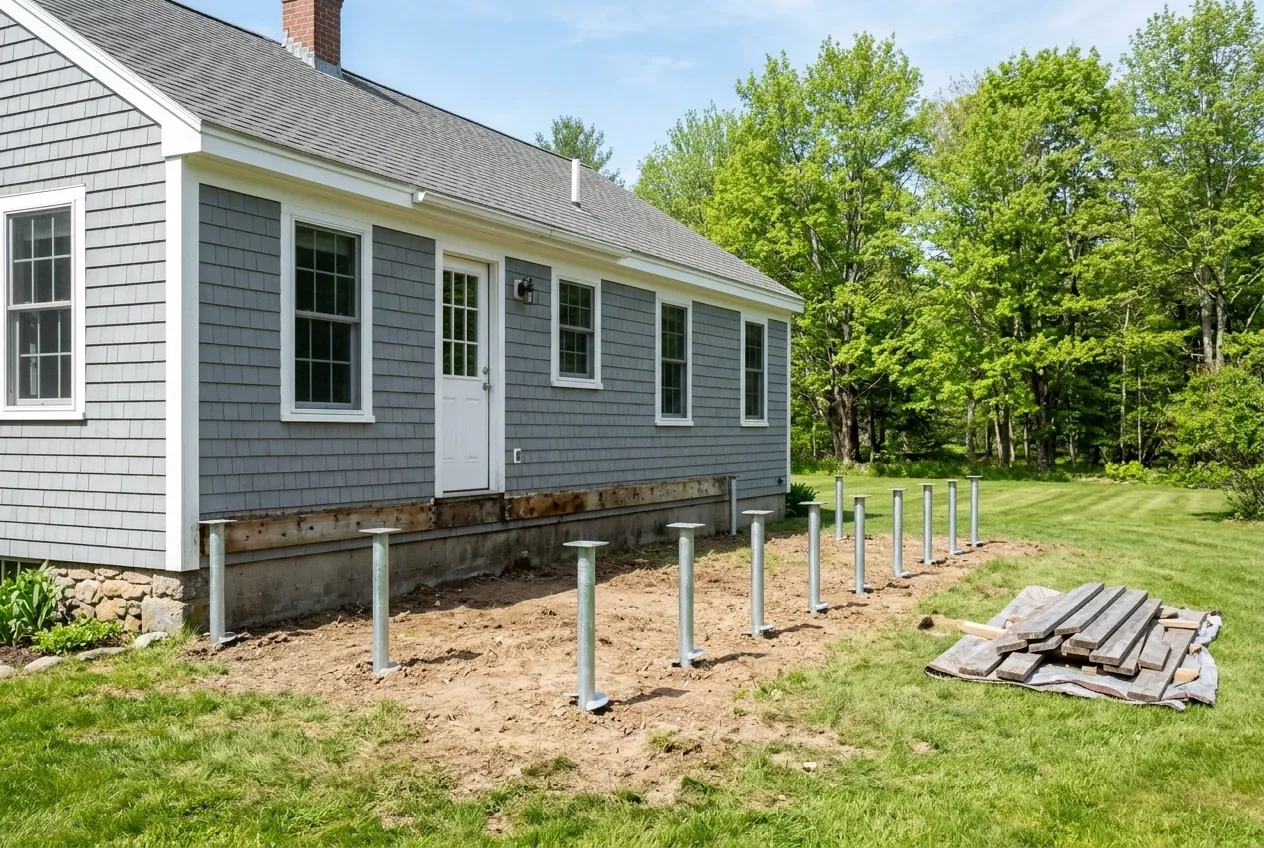
The town's Land Use Ordinance treats an attached deck as an attachment that takes its own permit, so Deck Builders Waterville files for it, keeps it 15 feet from every boundary and sets footings 4 feet down, on helical piles on most jobs.
The figure to keep: a simple pressure-treated deck in Mt. Vernon averages about $82 per square foot, and composite or PVC starts from $15,000. Both are averages across many quotes, never a price for your lot.
Why Does an Attached Deck Need Its Own Mt. Vernon Permit?
An attached deck needs its own Mt. Vernon permit because Section 3 of the Land Use Ordinance names a deck as an attachment, and attachments "require separate permits unless included in the original building permit application." A deck added to a house that is already standing was never in that first application, so its permit comes first.
- An attachment permit for a deck added to an existing house
- 15 feet from any boundary and 75 from the road's center line
- Accessory structures billed at 10 cents a square foot, $100 minimum
Get your free estimate request sent in 60 seconds!
Prepare your request below, then send it from your email app. Or call (207) 679-0381.
Which Towns Next to Mt. Vernon Do We Cover Too?
See all 22 towns we serveWhat Decks Work on Mt. Vernon's Lake and Hill Lots?
Mt. Vernon has 1,103 housing units, 29.0 percent of them held for seasonal use, so its decks divide between lake camps and year-round houses on wooded hill lots.
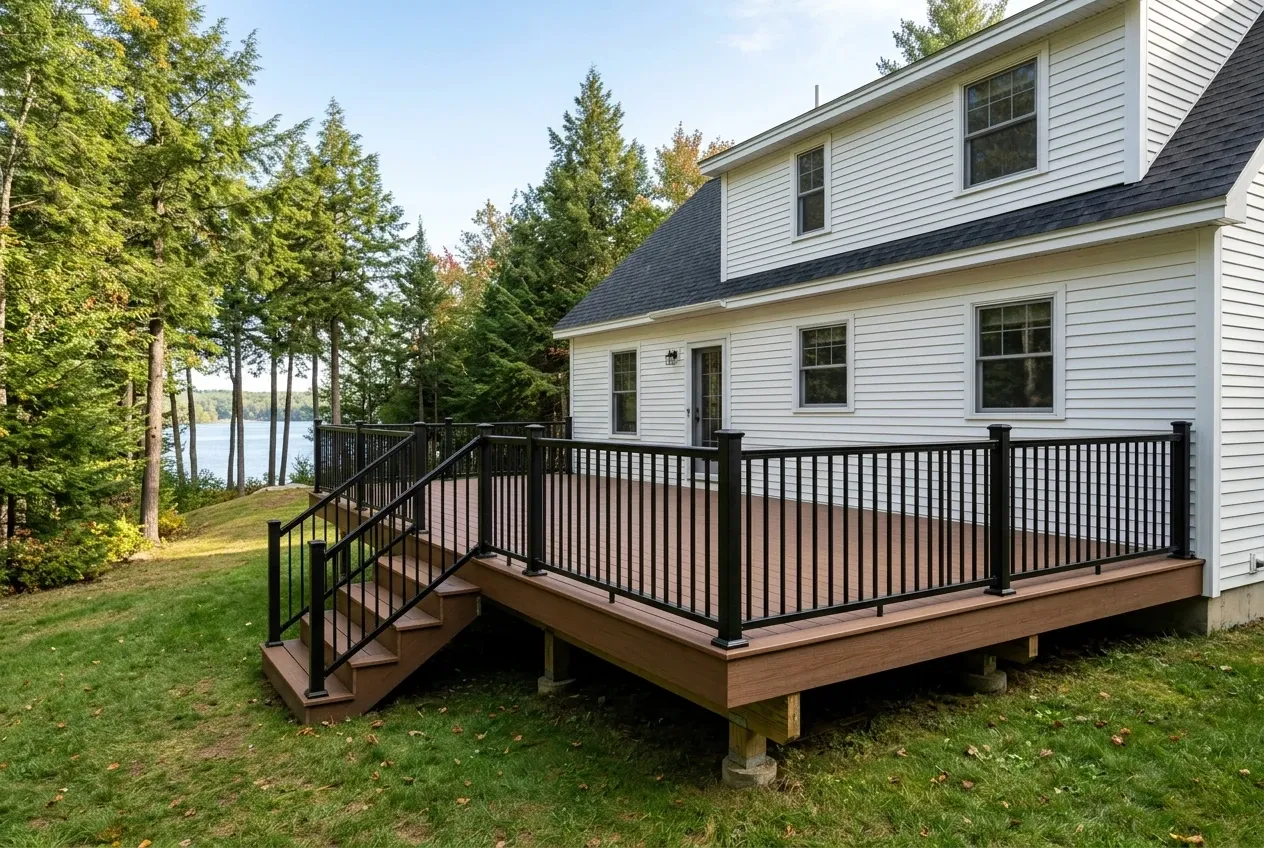
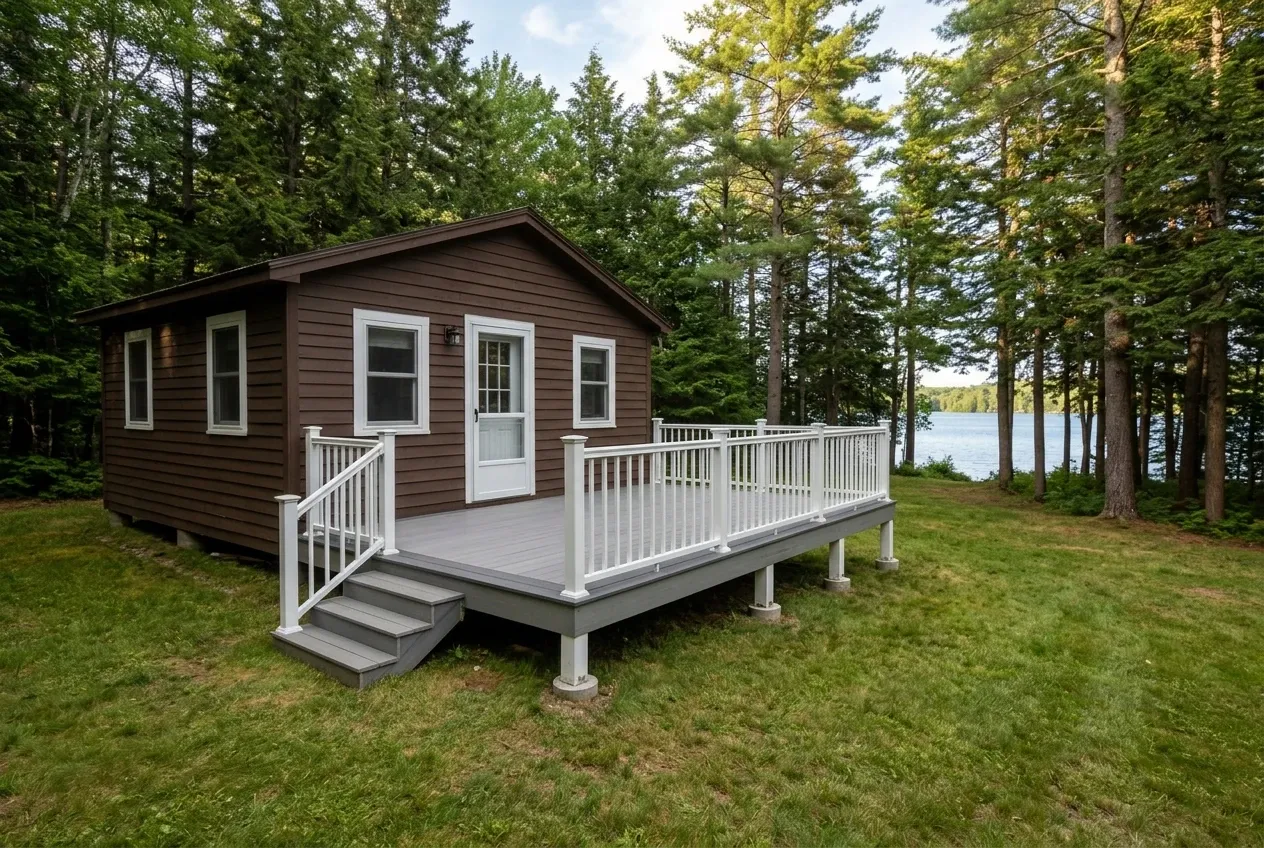
Composite Decks for Minnehonk Lake and Long Pond Camps
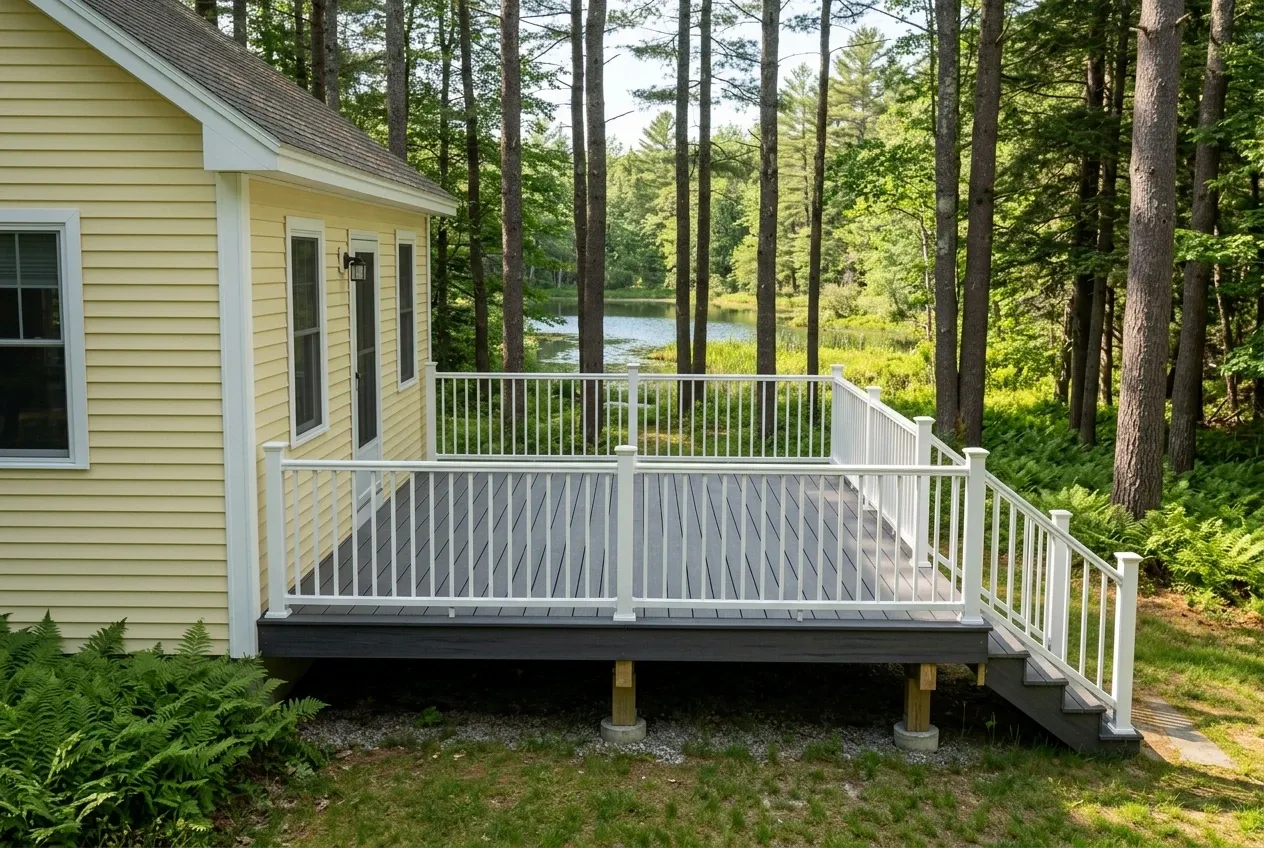
Composite decks are the better buy for a Mt. Vernon camp on Minnehonk Lake or Long Pond, since composite and PVC boards are never put on a stain-and-seal calendar. The town's 2019 draft plan calls Minnehonk, 99 acres lying wholly inside Mt. Vernon, "the centerpiece of the Town."
On a composite deck we wrap the edge in a picture-frame board, hiding every cut end of the decking, and we run the boards over joists 16 inches apart, or 12 under PVC. A great pond under the ordinance is any water over 10 acres in its natural state, and new structures sit 100 feet back from one.
Pressure-Treated Decks on Mt. Vernon's Wooded Lots
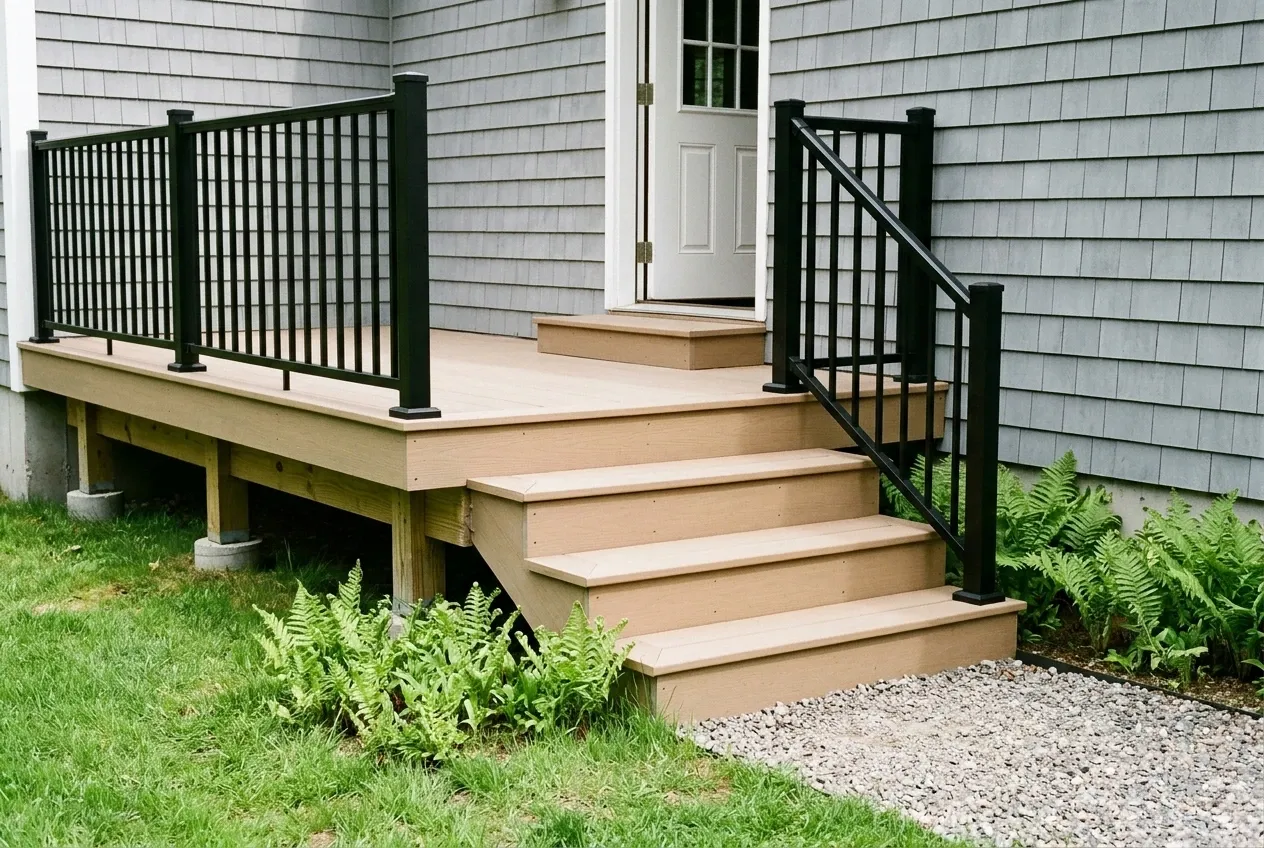
Pressure-treated decks fit Mt. Vernon's year-round houses, where the town's minimum lot of two acres leaves room to build out and the budget usually leads the choice. The median year built for the town's housing is 1978, so half of it has stood longer than any wood deck lasts.
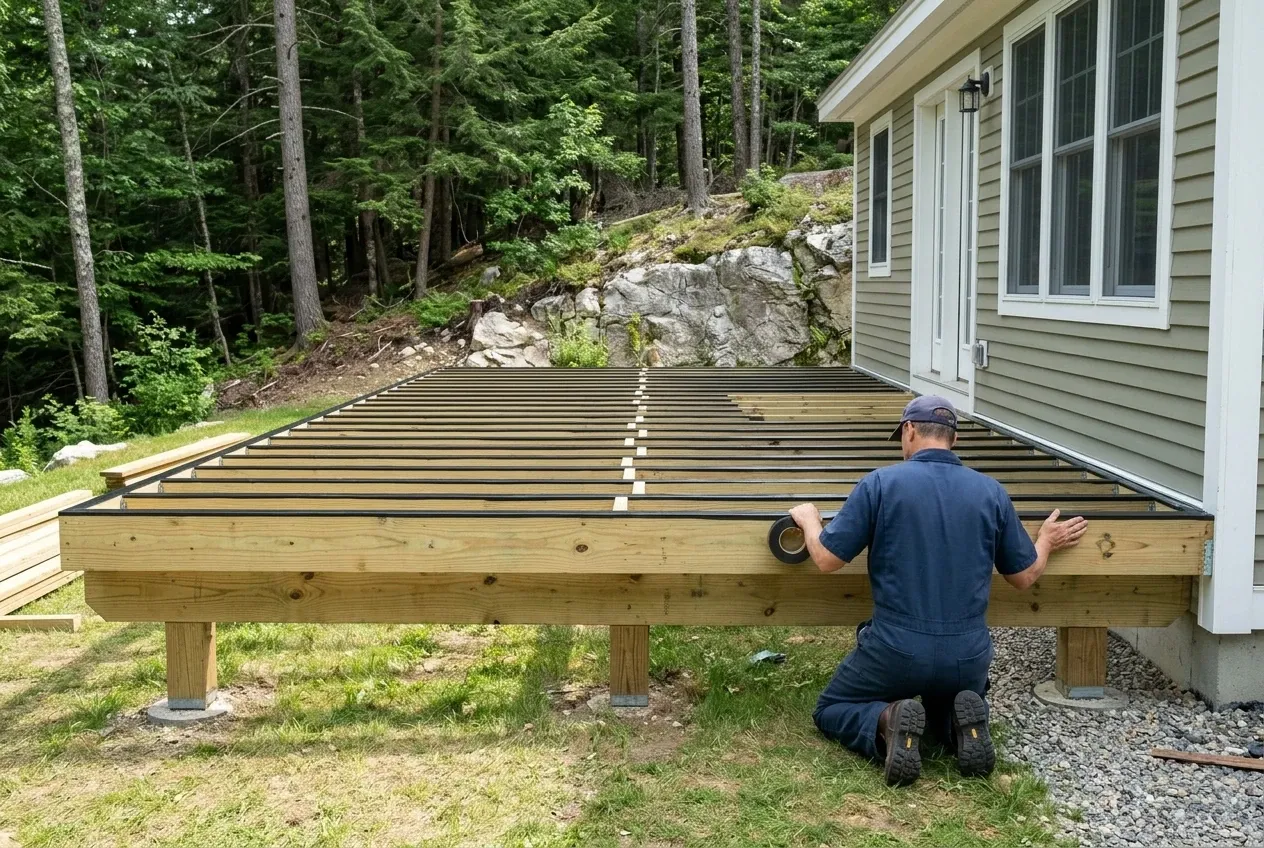
Treated decks still get our full frame, with footings below the frost, heavy beams and joist tape on every joist. On high ground we probe for rock before choosing a helical pile or a concrete pier.
Replacing a Deck Inside Mt. Vernon's Lake Setback
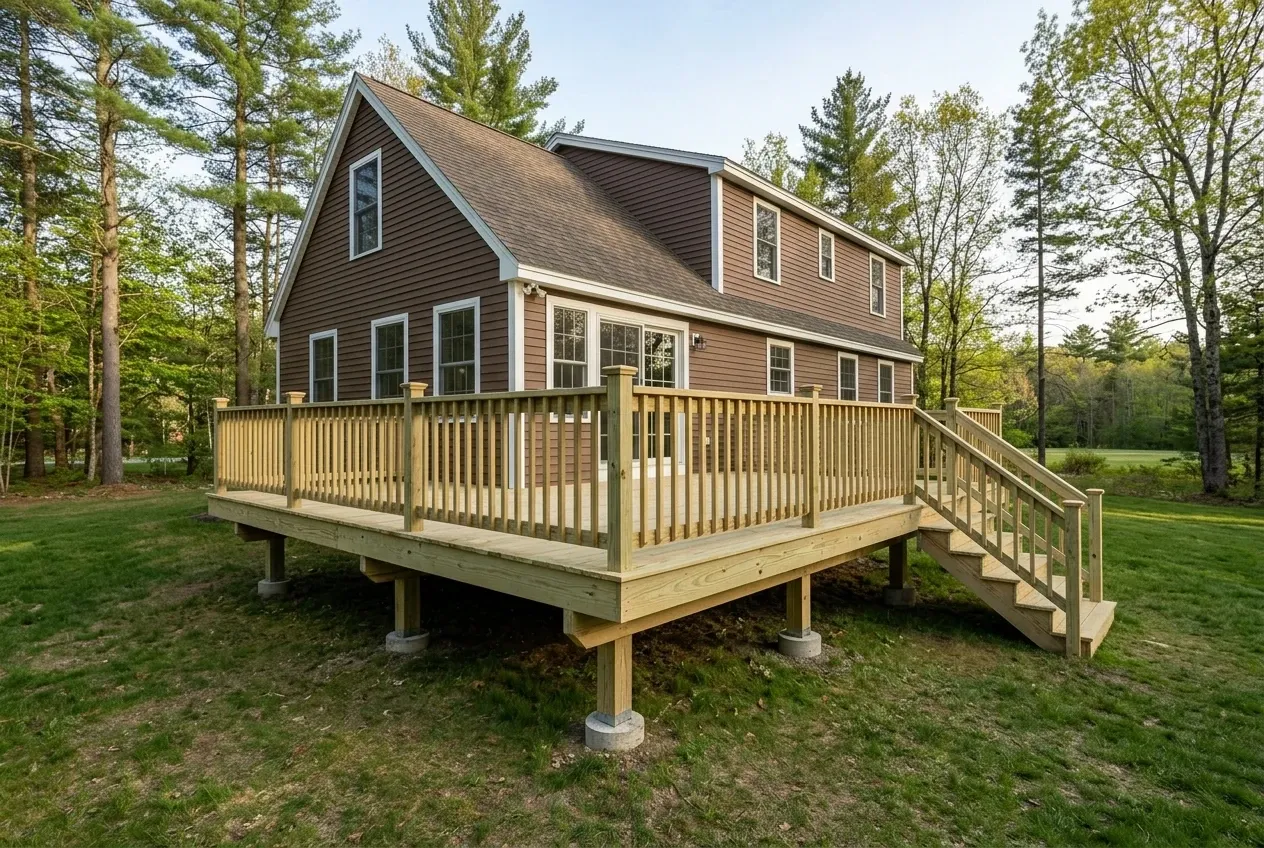
Deck replacement in Mt. Vernon is never a repair, because the ordinance says repair "does not mean to totally rebuild structures or attachments including decks." A full rebuild of an old deck therefore takes a permit, and we would not trade one for new boards laid over the old frame anyway.
A camp already inside the shoreland setback adds size limits: no expansion within 25 feet of the water, and inside 75 feet a ceiling of 1,000 square feet unless 30 percent on top of the January 1, 1989 footprint comes to more. Decks count in that footprint, so we plan on the old outline unless the numbers leave room.
What Deck Services Do We Offer in Mt. Vernon?
In Mt. Vernon our work falls into three of our services.
The Land Use Ordinance skips a permit only for accessory structures under 100 square feet in the rural district, outside the Shoreland Zone, and tells readers to assume anything not on that list needs one. The town's fee table adds $50 for a shoreland application but has no deck line, so we ask the code enforcement office which line applies and file every deck.
- Composite camp decks with trimmed edges
- Treated decks for year-round houses
- Permitted tear-out and full rebuild
How to Get a Mt. Vernon Deck Permitted and Built
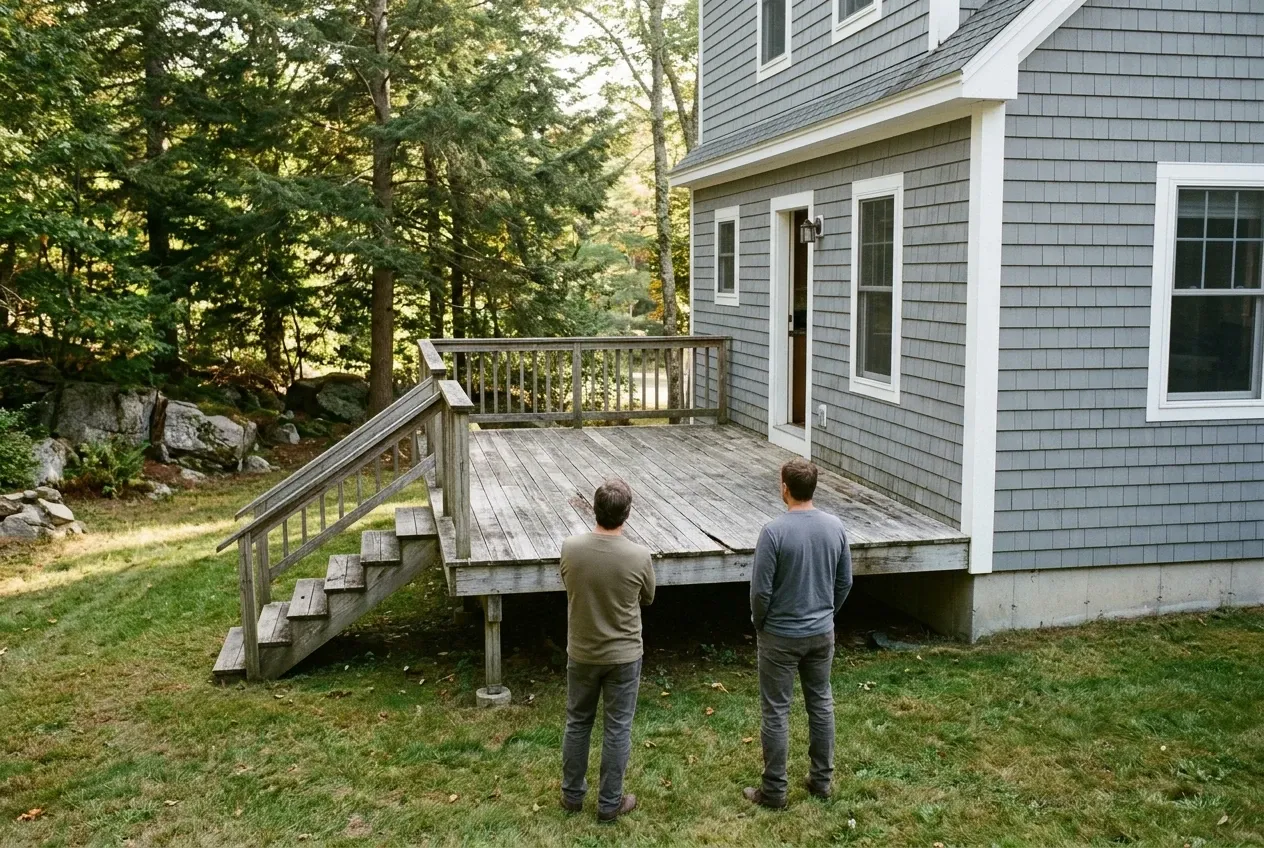
A walk around the lot, the lake side included.
We go over the yard, the house wall and whatever deck stands there now, and we tape the distance to the water, to each boundary and to the center of the road.
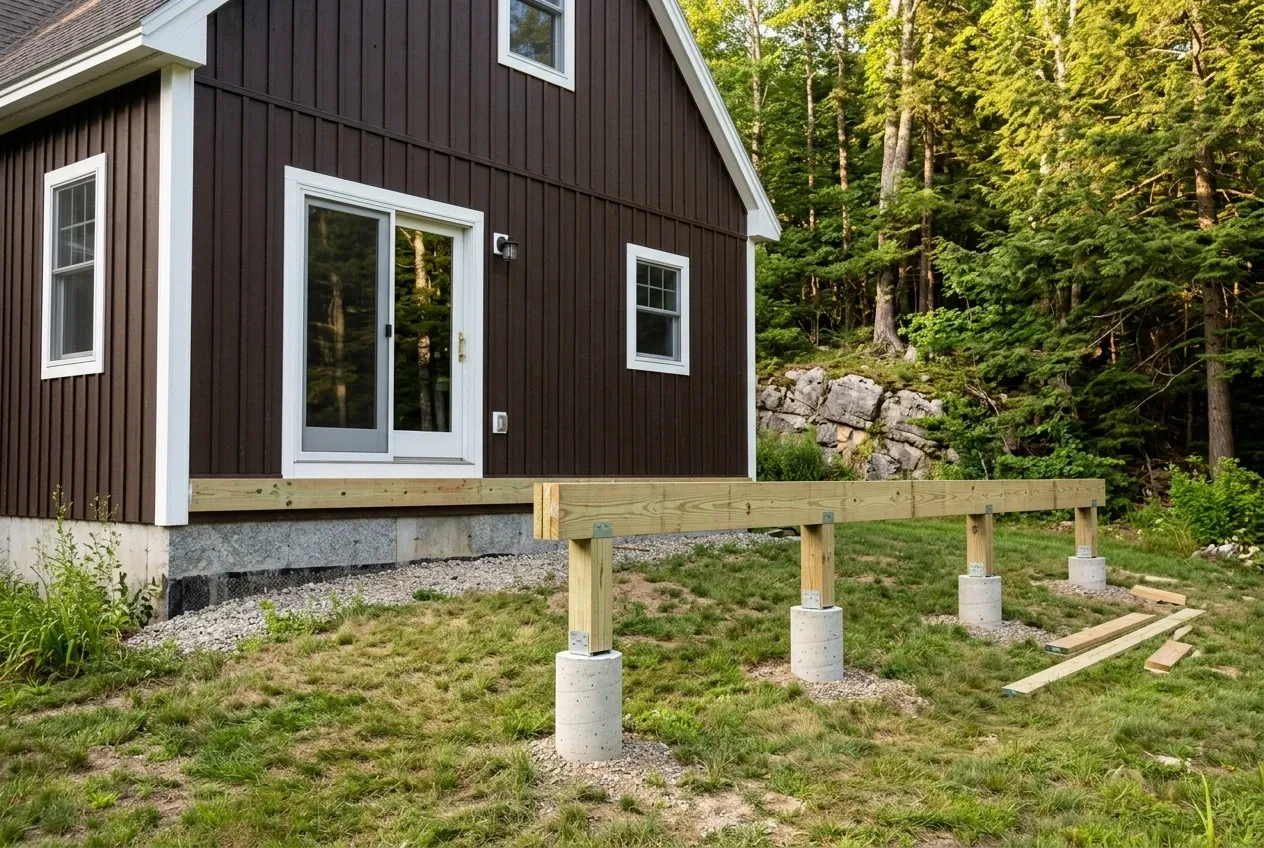
Price on paper, signature on a contract.
The price is on paper before the permit goes in, and a Mt. Vernon job over $3,000 needs the signed contract that 10 MRSA §1487 describes, with no deposit above one third of the job.
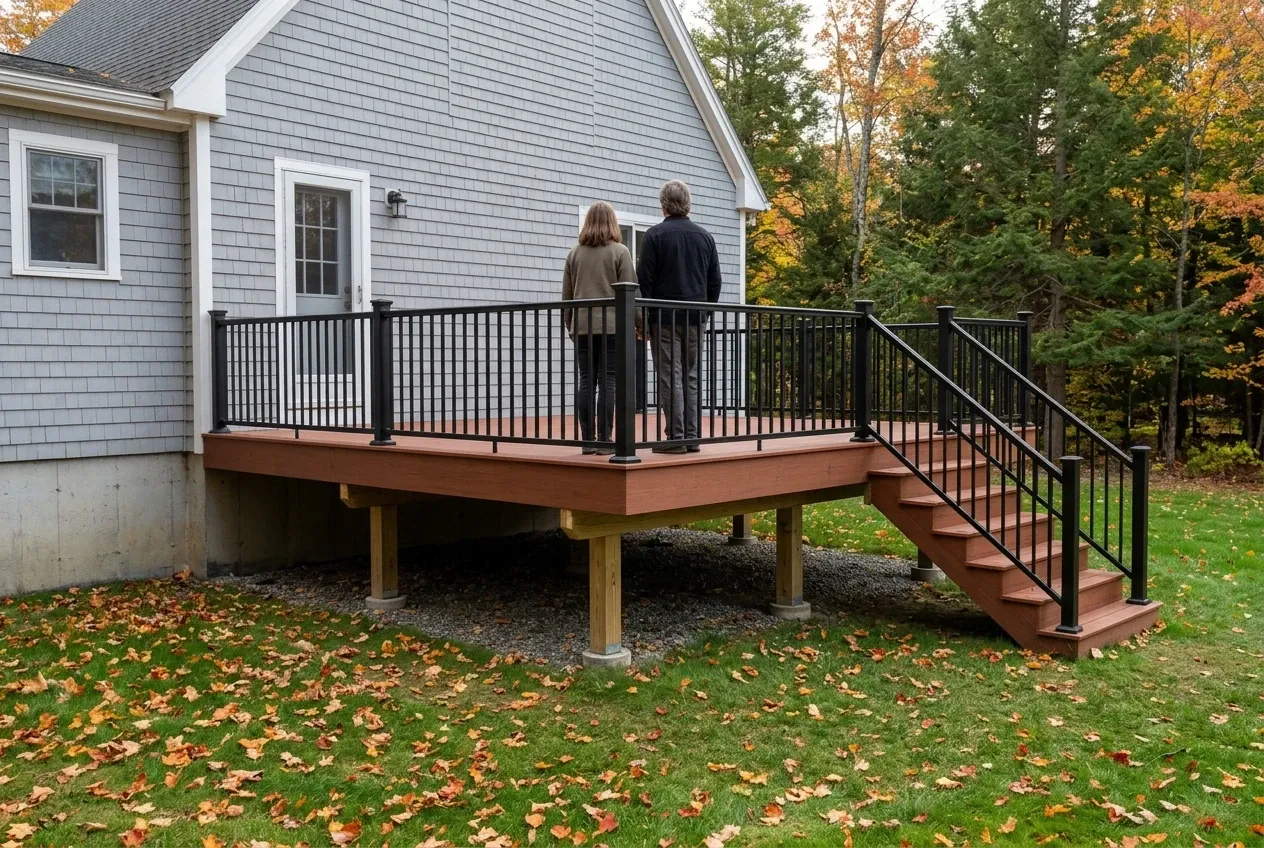
Footings, frame, boards, then a walk together.
The ground work and frame come first, then the decking, rail and stairs, and on a shoreland job we take the town's photos before work and again within 20 days of finishing. We remove the old deck from the property and walk the new one with you when it is done.
What Should Deck Builders in Mt. Vernon, ME Check First?
Deck builders in Mt. Vernon, ME should check the ground under each post first, since a hill lot's slope and soil can change across one yard. We set footings 4 feet deep, beneath the frost line (the level winter frost reaches underground), usually on a helical pile (a steel screw-shaft wound down into the soil).
Second is the house. A ledger (the plank bolted to the house rim, carrying the deck's house side) goes on only under metal flashing, and a wall that cannot hold one properly means a freestanding deck on a second beam.
Third is the town, whose shoreland rules set new structures 100 feet off a great pond or a river, 75 off a stream, and on an average slope over 20 percent the town may add 25 feet per 5 points of grade, up to 50 feet more.
Who Issues Mt. Vernon Deck Permits, Where and When?
Which office grants a Mt. Vernon deck permit?
The office that grants a Mt. Vernon deck permit is the Code Enforcement Officer or the Building Inspector, who owes a permit or a written denial within 15 days of a complete application under Section 11. Applications go in through the town's online permit portal, with payment to the Town Clerk in person or by mail.
Where on a Mt. Vernon lot may a deck stand?
A deck may stand on a Mt. Vernon lot no closer than 15 feet to any boundary line and no closer than 75 feet to the road's center line, or 50 feet in the Village District. On the water it must also clear the shoreland setback, which the town may widen on a steep lot.
When does a Mt. Vernon deck permit lapse?
A Mt. Vernon deck permit lapses if work has not substantially started within two years in the Rural Zone, or one year in every other zone. Work begun without a permit pays a double fee, so we file before any digging.
How Much Does a Mt. Vernon Deck Run?
A Mt. Vernon deck runs about $82 per square foot for a plain treated build, and $103 to $123 per square foot for a layout with more size, levels or angles, both averages drawn from many quotes. Treated decks start at $10,000 for a full build, while composite or PVC boards with composite rail start from $15,000.
| Deck | What it usually means | Average |
|---|---|---|
| Pressure-treated, simple layout | one level, a handful of steps, treated boards and treated rail | about $82 per square foot, nothing new under $10,000 |
| Bigger or more complex layout | a second level, angles, a wraparound, stairs toward the lake | $103 to $123 per square foot |
| Composite or PVC | composite or PVC boards with composite rail | from $15,000 |
Installed Mt. Vernon averages from many quotes, footings through the last stair tread. They are budget guides, not quotes, and height, a long stair or a rotten old frame can move any one lot's number.
Why does a small Mt. Vernon deck cost more for each square foot?
A small Mt. Vernon deck costs more for each square foot because the footings come in at nearly the same price on a small deck as a large one. The jump from a 10x10 deck to a 12x16 usually runs near $1,000, and that bigger deck is most often the better value.
What sets where a Mt. Vernon deck lands in the range?
Where a Mt. Vernon deck lands in the range is set by a ramp first, the stair count second, reusable footings third, the layout's shapes and levels fourth and the height last. Above about 2 feet, staging adds near one day of crew time, and a small deck carries that day as a big part of its price.
How does a replacement change a Mt. Vernon deck price?
A replacement changes a Mt. Vernon deck price by adding the demolition, the disposal and any new footings the old posts cannot supply. We decide at the house which old posts or footings can stay, and the price follows that visit.
Planning a Deck by Minnehonk or Up in the Hills?
Start with a free estimate request: we measure your Mt. Vernon lot to the water, the lines and the road, then write one price that covers footings, frame and boards.