
Full-Service Deck Replacement | Deck Builders Waterville
Deck replacement with us means the whole deck from the ground up: the old one comes off, new footings go 4 feet into the soil and a new frame is built before a single board is laid. To price it, we crawl under the old deck with a screwdriver and a flashlight and probe its posts, its joists and the board fastened to the house.
- (207) 679-0381
- 143 Silver St, 2nd Floor, Waterville
- [email protected]
- Decks only, footings to rail
- Free estimate requests
- 22 central Maine towns, Waterville to Skowhegan
- The old deck probed before it is priced
- A new frame on new footings, every time
- Tear-out and haul-away in the written price
This page explains how Deck Builders Waterville handles deck replacement across central Maine, with the old deck taken down to the ground and then new footings, a new frame, new boards and new stairs and rail.
It is for owners whose deck has turned bouncy or soft, pulls at the house wall, or has been patched board by board. What sets the work apart is a look under the old deck before any price, and a refusal to lay new boards over an old frame.
The figure to keep, averaged across many quotes: a simple treated replacement runs about $80 per square foot, nothing new is built under $10,000, and composite or PVC with composite rail starts at $15,000.
Why Do We Replace the Frame, Not Only the Boards?
We replace the frame and not only the boards because a frame fails out of sight, and new boards on old joists put a fresh face on the same tired structure. Trex's own resurfacing guide says decayed or cracked framing has to be replaced before new boards go on, and on a wood deck near 20 years old we find that is most of the frame.
- Every post and joist probed before a price
- New footings 4 feet down, under the frost
- A flashed ledger, or a deck on its own posts
Which Deck Do You Want in Place of the Old One?
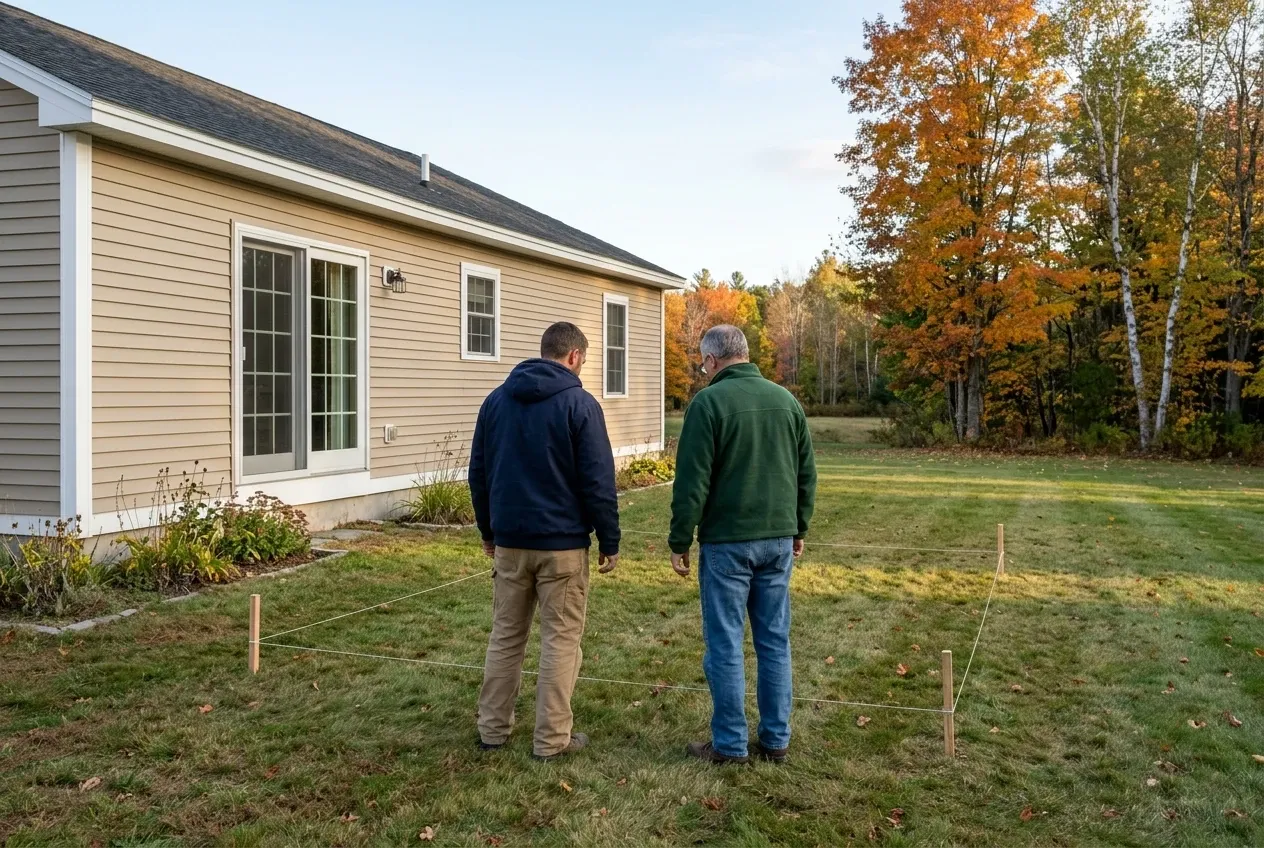 Composite DecksCapped composite or PVC boards over a pressure-treated frame with joists set for the boards.See Composite Decks
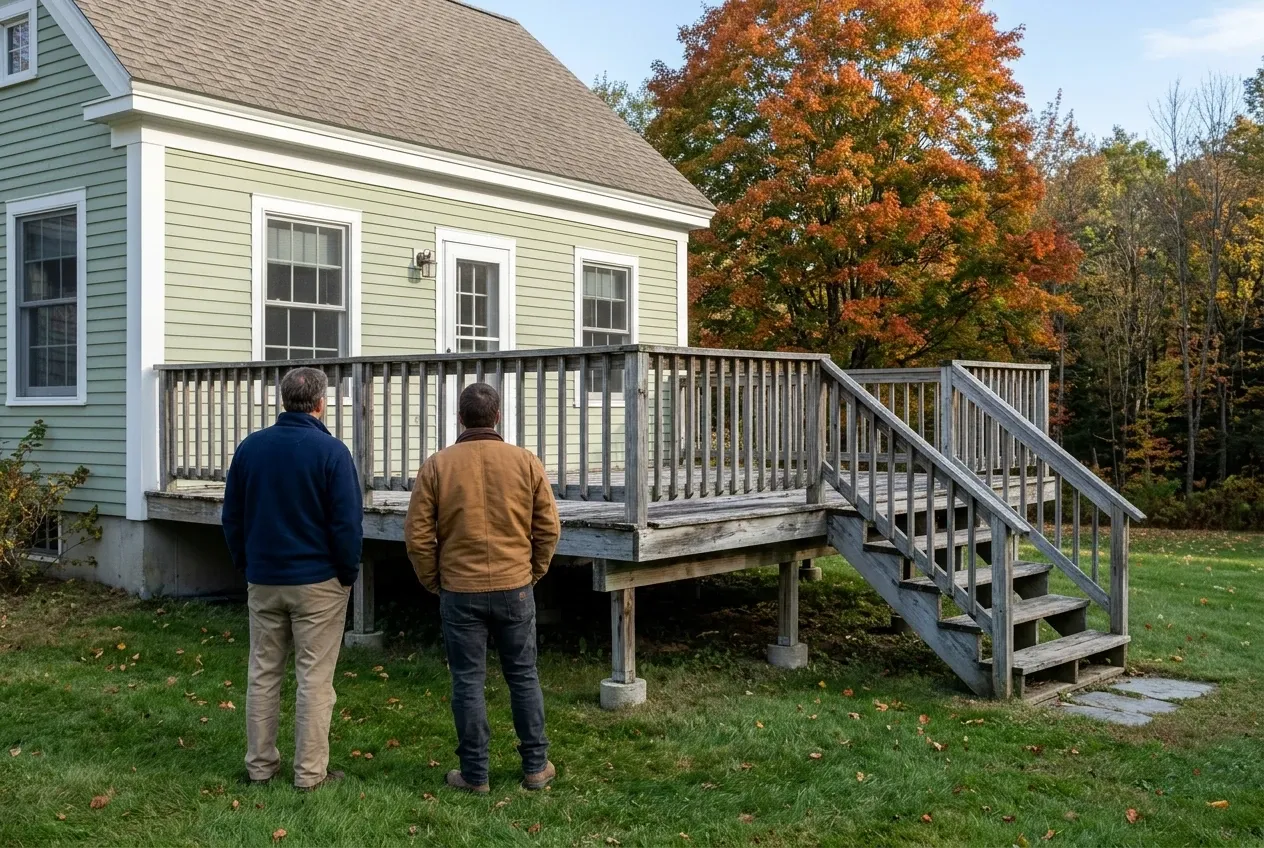 Pressure-Treated DecksThe most affordable deck, framed and decked in treated lumber.See Pressure-Treated Decks
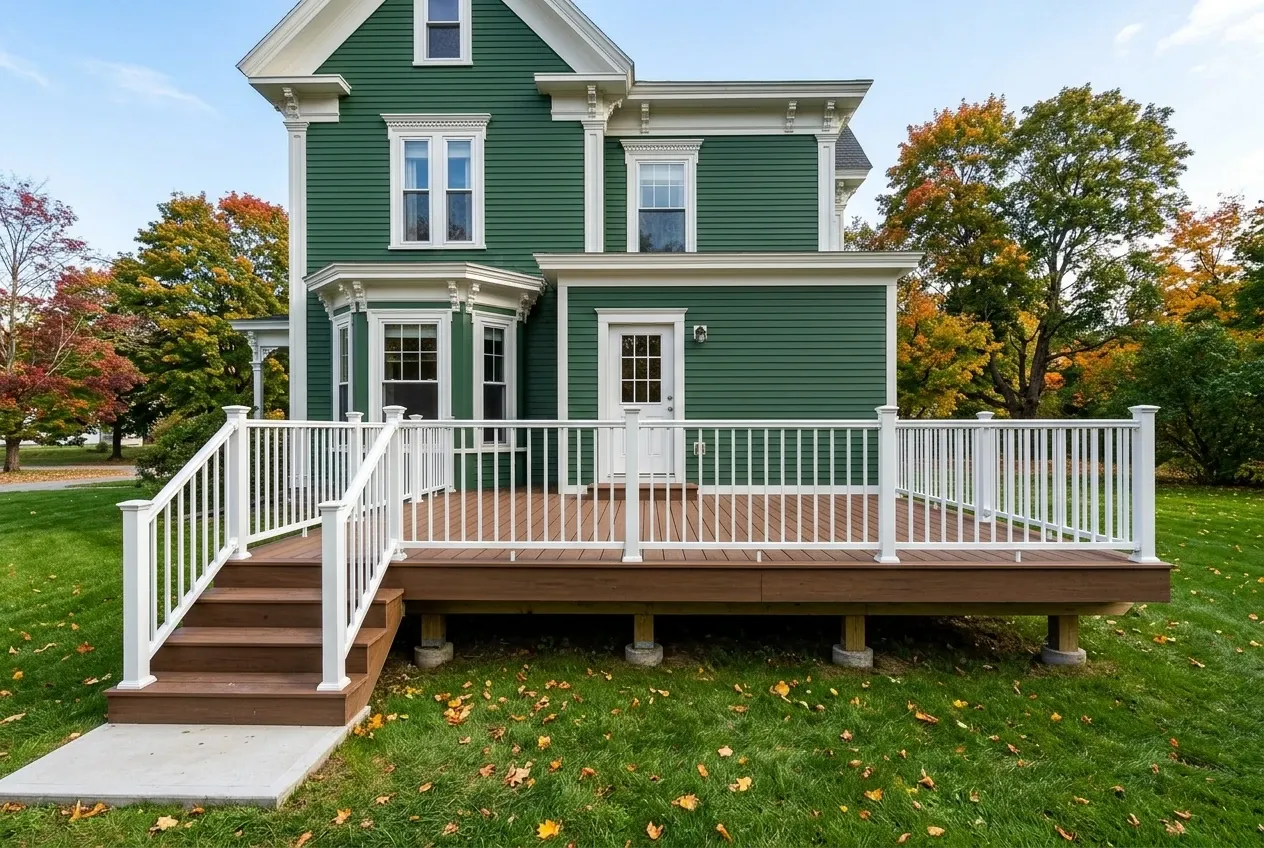 Deck Builders in Waterville, MESee Deck Builders in Waterville, ME
Where Do We Tear Out and Rebuild Old Decks?
- OaklandME4 mi from Waterville
- WinslowME4 mi from Waterville
- FairfieldME7 mi from Waterville
- BentonME8 mi from Waterville
- VassalboroME8 mi from Waterville
- SidneyME9 mi from Waterville
- BelgradeME9 mi from Waterville
- SmithfieldME10 mi from Waterville
- ClintonME10 mi from Waterville
- AlbionME11 mi from Waterville
- ChinaME11 mi from Waterville
- RomeME12 mi from Waterville
- MercerME14 mi from Waterville
- UnityME15 mi from Waterville
- AugustaME15 mi from Waterville
- NorridgewockME15 mi from Waterville
- PalermoME15 mi from Waterville
- SkowheganME15 mi from Waterville
- Mt. VernonME16 mi from Waterville
- FreedomME16 mi from Waterville
- BurnhamME16 mi from Waterville
What Happens When an Old Deck Comes Out?
A replacement turns on three questions: whether the old deck is finished, what goes in under the new one, and how big the new one should be.
Signs an Old Deck Has Reached the End
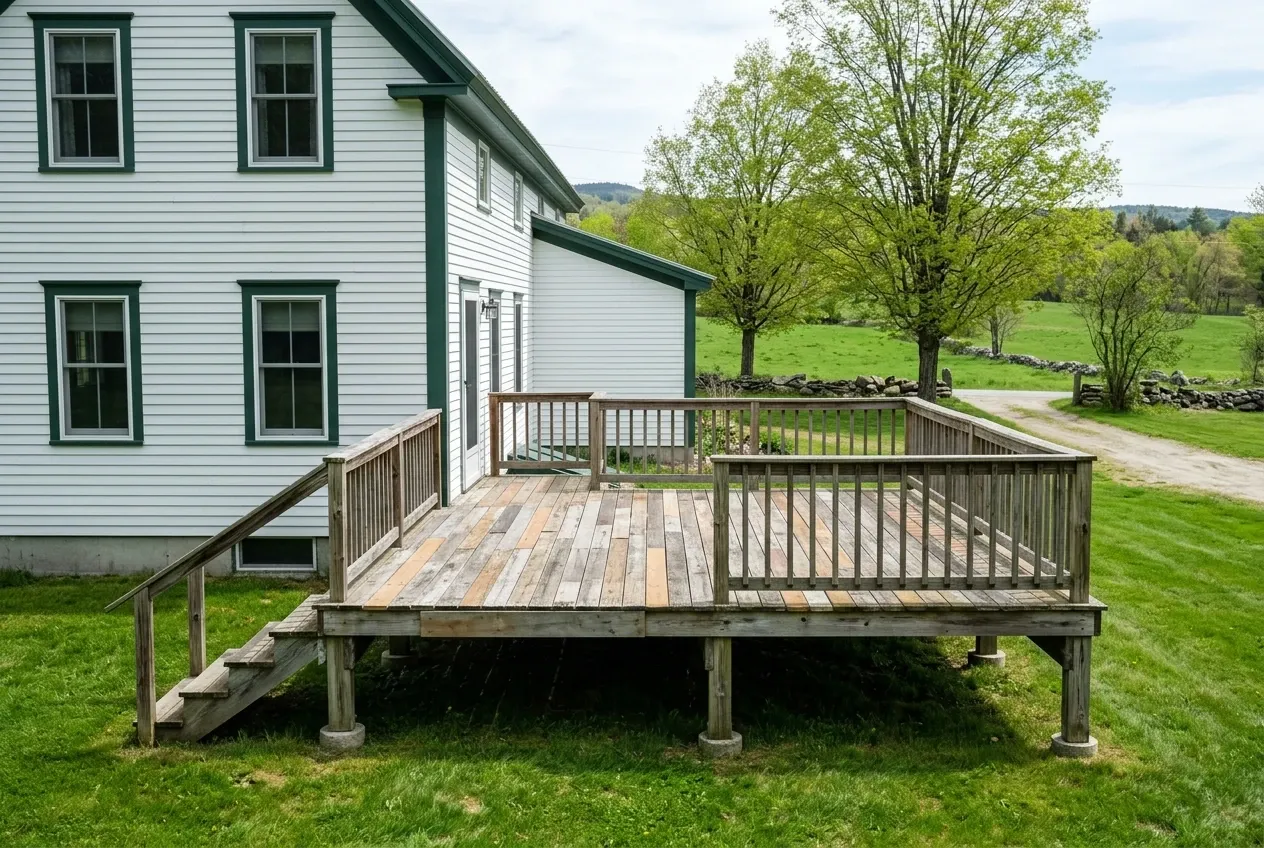
Owners usually call when the deck feels bouncy or spongy, the stairs wobble, it moves when someone walks across it, or it seems to be pulling away from the house. Behind those complaints we usually find soft joists, rusted hangers, heaved blocks under the posts, or a ledger hung on nails where bolts belong.
You can check two things yourself before we arrive. Probe a joist from below with a flathead screwdriver, the way Trex's resurfacing guide suggests for finding soft spots, and look at the board against the house, since NADRA says that if nail heads are the only hardware you can see on it, treat the deck as unsafe and have it inspected.
Age is the other clue: in our experience a wood deck is done by about 20 years, and the surest sign is a patchwork of boards swapped one at a time as each got dangerous.
Tear-Out to the Footings, Then a New Frame
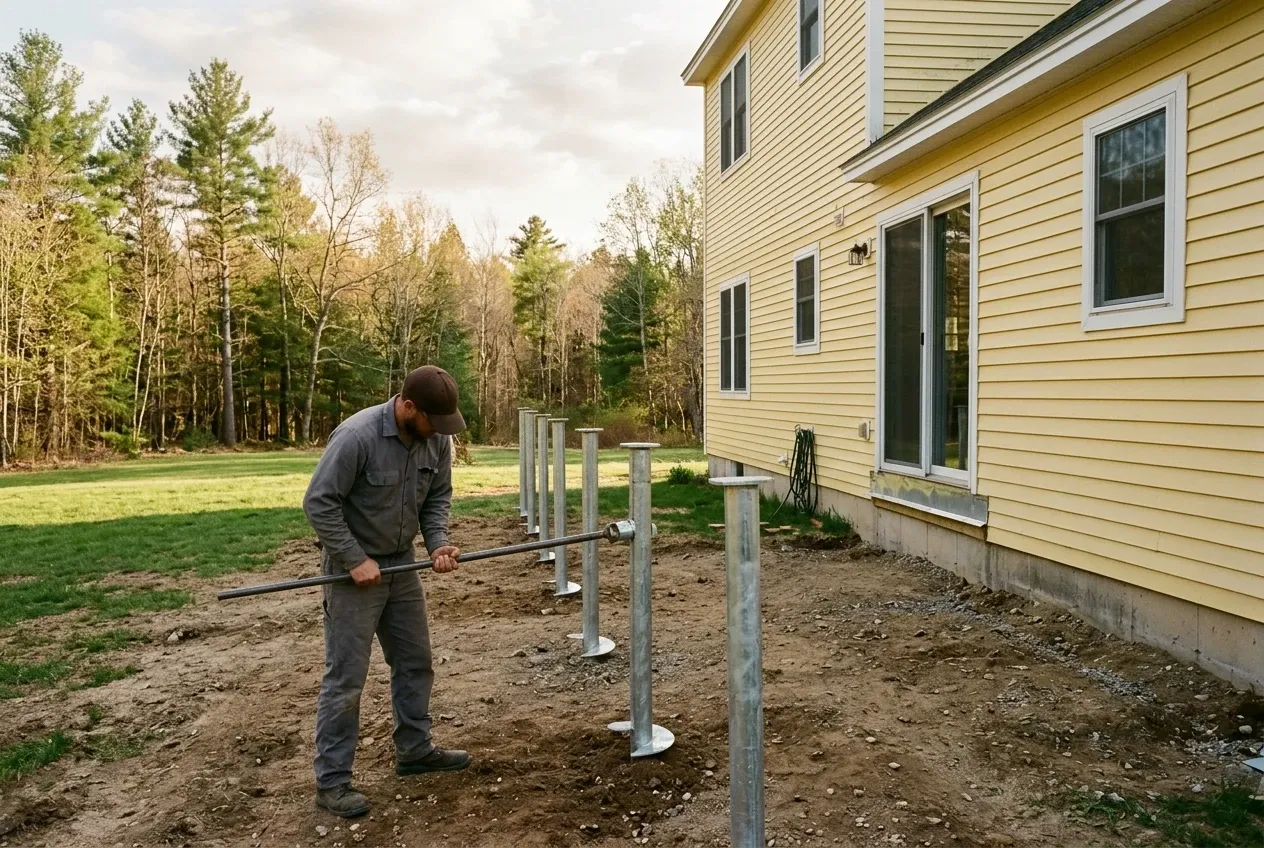
The old deck comes down to the ground, and new footings (what each post bears on) go 4 feet down as helical piles, each a steel shaft with a corkscrew blade near its tip wound into the soil, or as a concrete pier at a spot that needs one. DCA 6, the deck construction guide from the American Wood Council, sets its minimum at 12 inches below undisturbed soil or below the frost line, whichever is deeper, and sends you to the local code office for the frost depth.
The new frame is built heavier than the minimum, and where it meets the house, DCA 6 has the siding taken off so flashing (a metal or membrane cap that keeps water out of the joint) can go behind the new ledger, the board that fastens a deck to the house. If the house band joist is under an inch thick or has gone soft, we build freestanding, a deck that stands on its own posts with no ledger at all.
The old lumber leaves with us. Maine DEP says it is illegal to burn treated wood, so a careful tear-out ends at a disposal site, never on a burn pile out back.
Same Footprint or Bigger When the Old Deck Comes Off
A replacement is the cheapest moment to go bigger, because the footings cost about the same whatever the deck's size, and a 12x16 where a 10x10 stood often runs only around $1,000 more.
A bigger deck still has to fit the lot: the town's setbacks apply, and on a lake or river lot the shoreland rules decide how close a deck sits to the water and how much a structure may grow. Several towns we work in treat an attached deck as one piece with the house, and Maine DEP's shoreland zoning page covers the state program those town rules come from.
Permit rules are set town by town, and the State's building code page adds that meeting the code falls to the owner even in a town that does not enforce it. We call the code office before the first post hole, apply for whatever permit the town requires, and the town alone decides on approval.
What Deck Replacement Services Do We Offer?
Everything from scoping the tear-out to the last walk-through sits inside one replacement job.
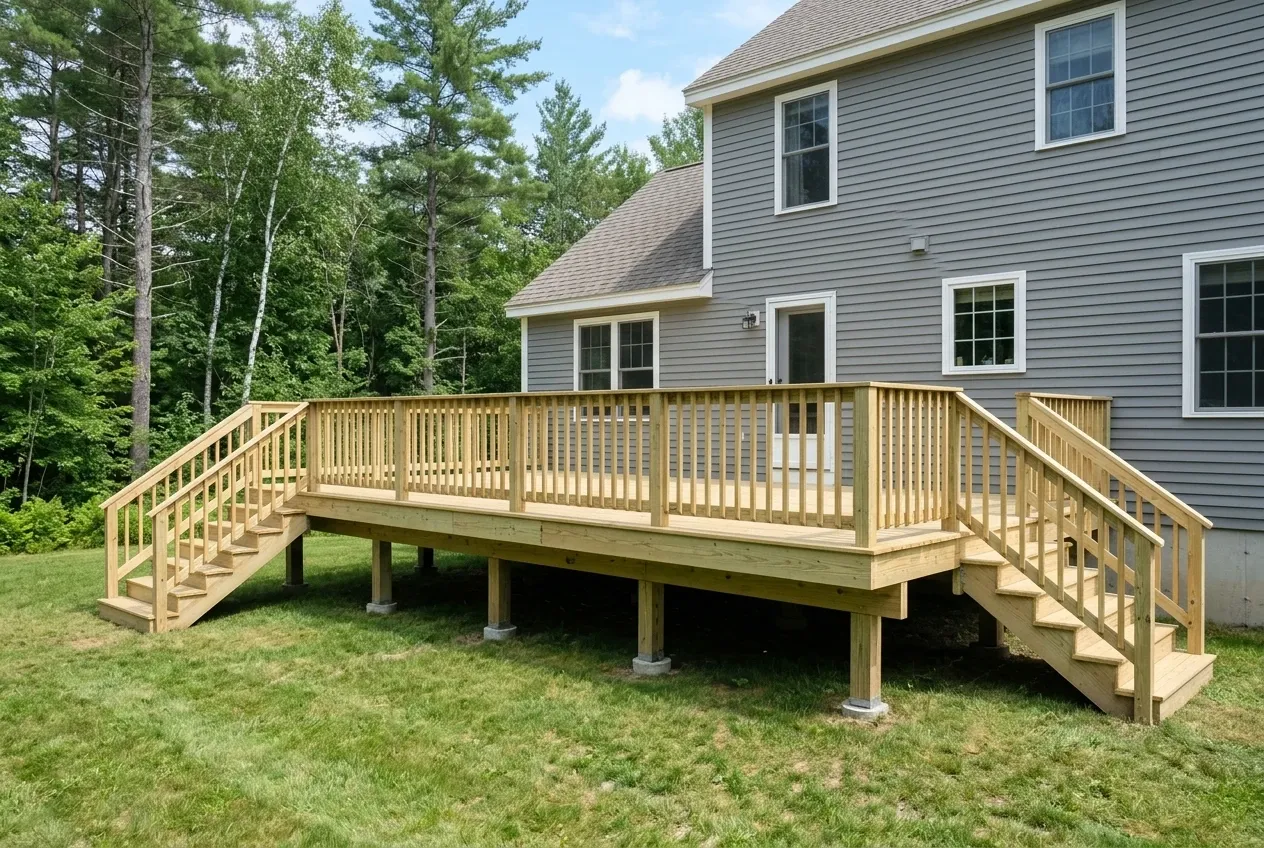
The new rail and stairs follow current rules, not the old deck: DCA 6 requires a guard (the code's word for the railing on an open side) on decks more than 30 inches above grade, with its top at least 36 inches high and no opening larger than a 4 inch sphere. The same guide puts stairs on stringers (the sawtooth boards that hold the treads) of at least 2x12 and makes them at least 36 inches wide.
- Tear-out scoped first, then demolition and disposal
- Helical piles or concrete piers under every post
- New frame, decking, guards, stairs and landings
How to Take Down an Old Deck and Build the New One
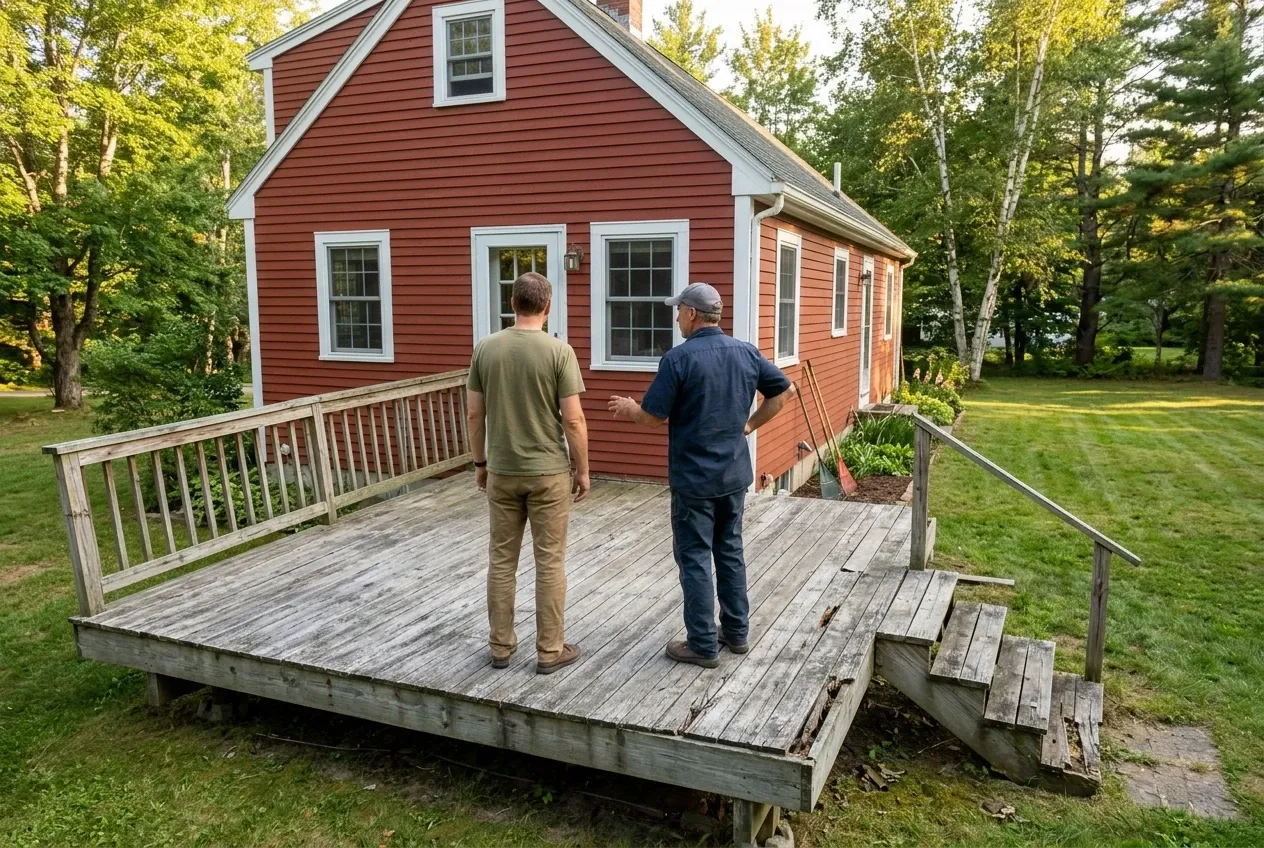
We get under the old deck before we price it.
We probe the posts, joists and ledger, look at the house wall behind the ledger, and check how deep the old footings sit. You hear what we found, and whether a repair or a full replacement is the right call, before any number is written.
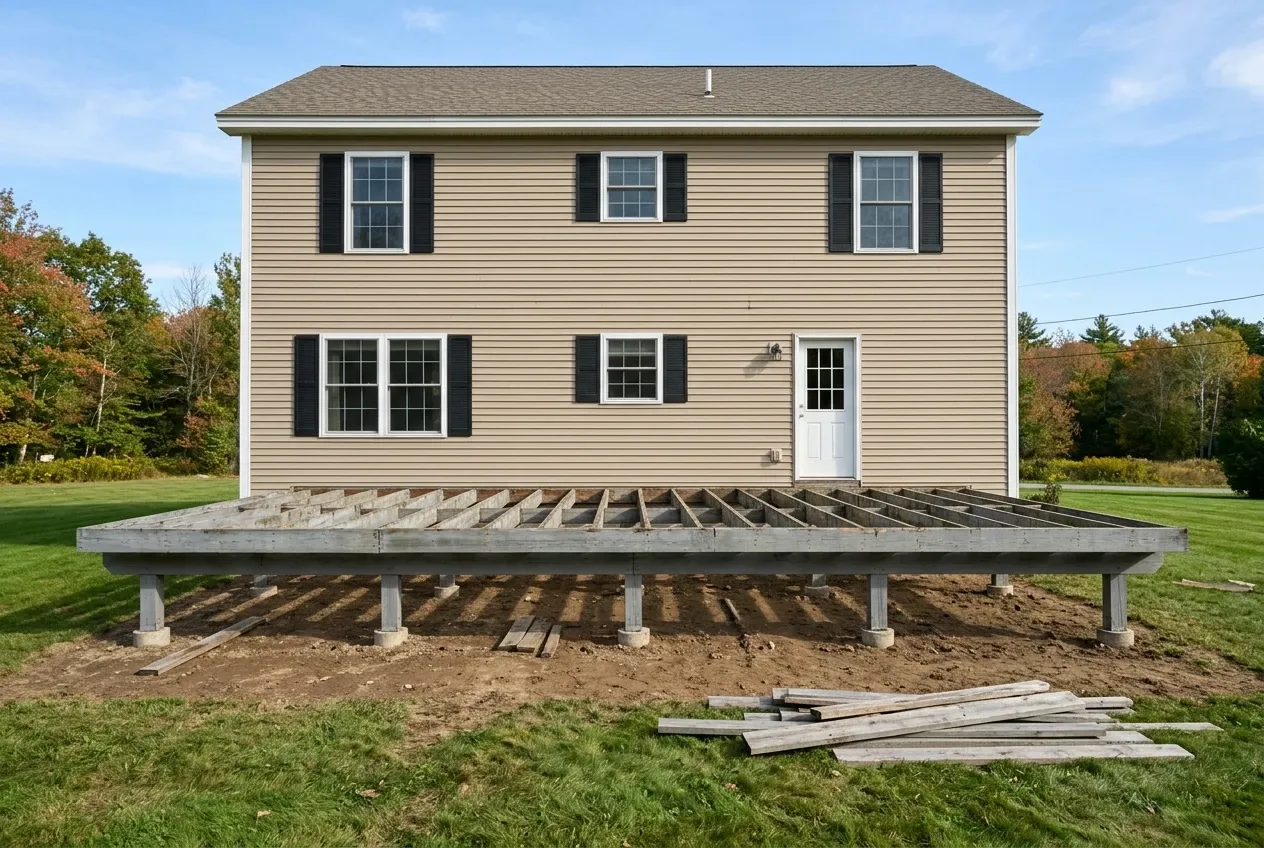
A written price, a signed contract and a third down at most.
The written price lists tear-out, footings, frame, boards, rail and stairs on separate lines, and once the total tops $3,000, Maine's home contract law, 10 MRSA §1487, requires the contract in writing with your signature and ours. If the wall behind the old ledger turns out soft, we stop, show you and write up any change before going on, and any permit the town requires is ours to pull.
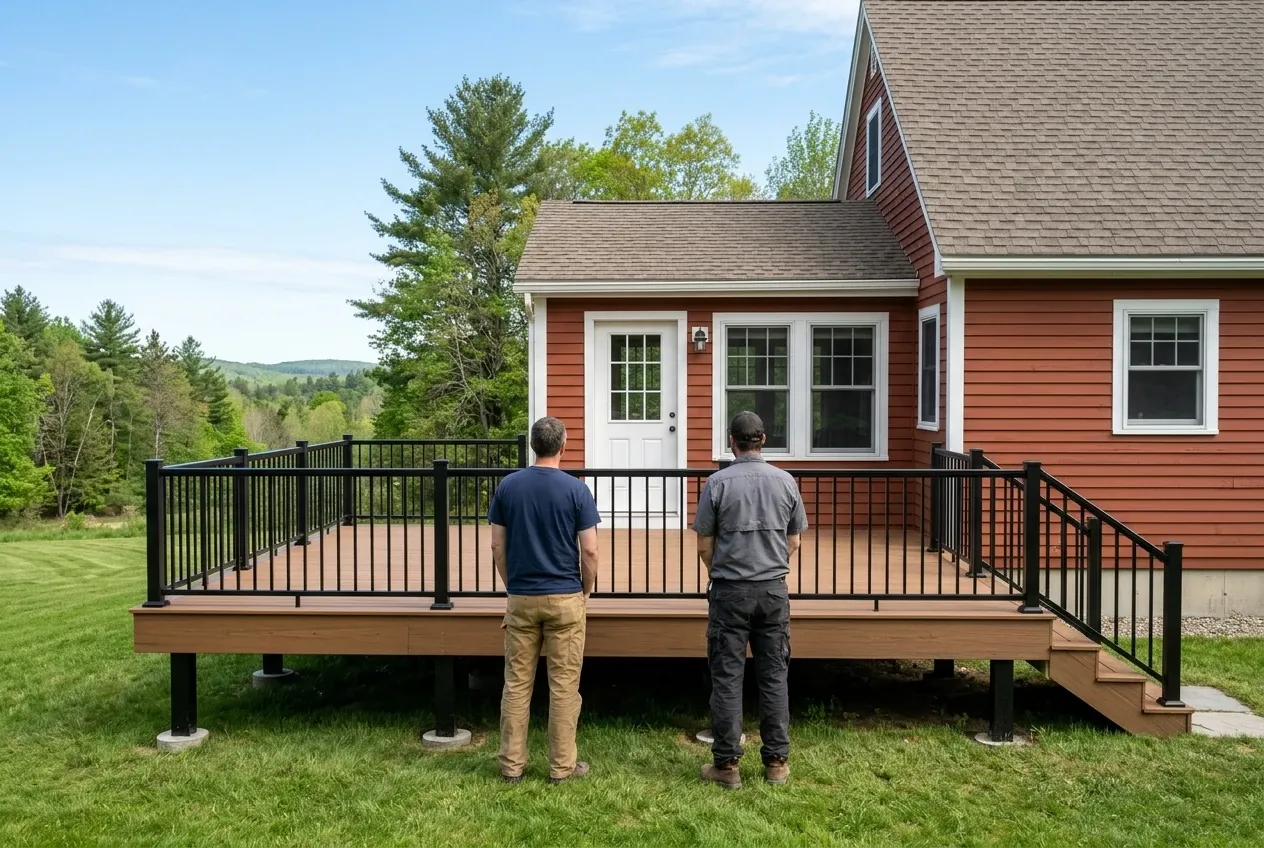
Tear-out first, then footings, frame and boards.
The old deck comes down and goes off on our truck, the new footings and the taped frame go in, and then the boards go down with the rail and stairs last. At the end you walk the finished deck with us.
Is Deck Replacement Smarter Than Fixing the Old Deck?
Deck replacement is the smarter move once the frame is going: soft joists, a ledger with no flashing, posts that have heaved, or a deck nearing 20 years whose boards have been swapped piecemeal. Fixing pieces of a failing frame spends money on the part that is already used up.
It is not the right call for a newer deck with one loose stair, a wobbly rail post or a single cracked board on a sound frame. We look at that kind of problem at the visit and tell you plainly whether a repair makes more sense.
What we refuse is the middle road of new boards screwed over an old frame. Framing is a modest share of what a deck costs, which makes skimping on it under new composite a poor trade.
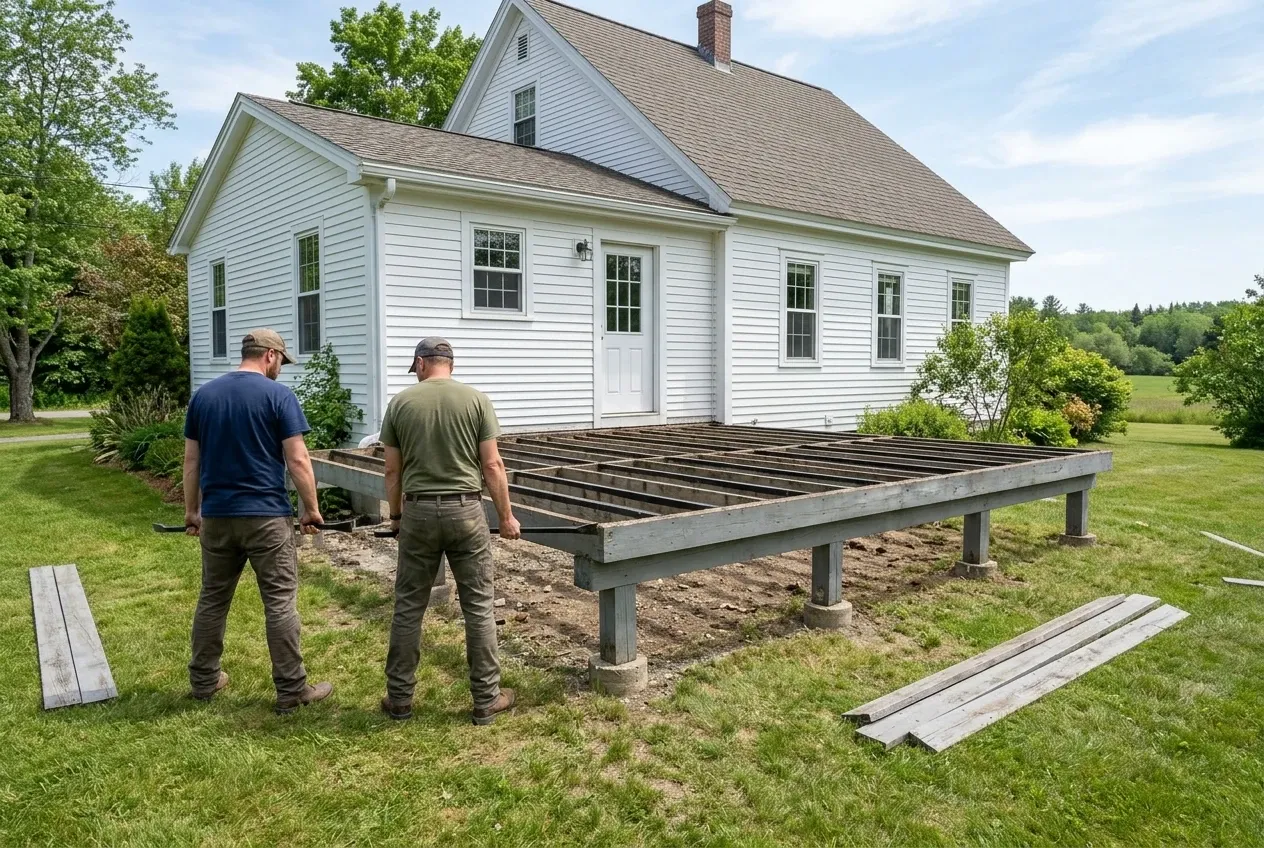
Who Should Replace, Where Does Rot Start, and When?
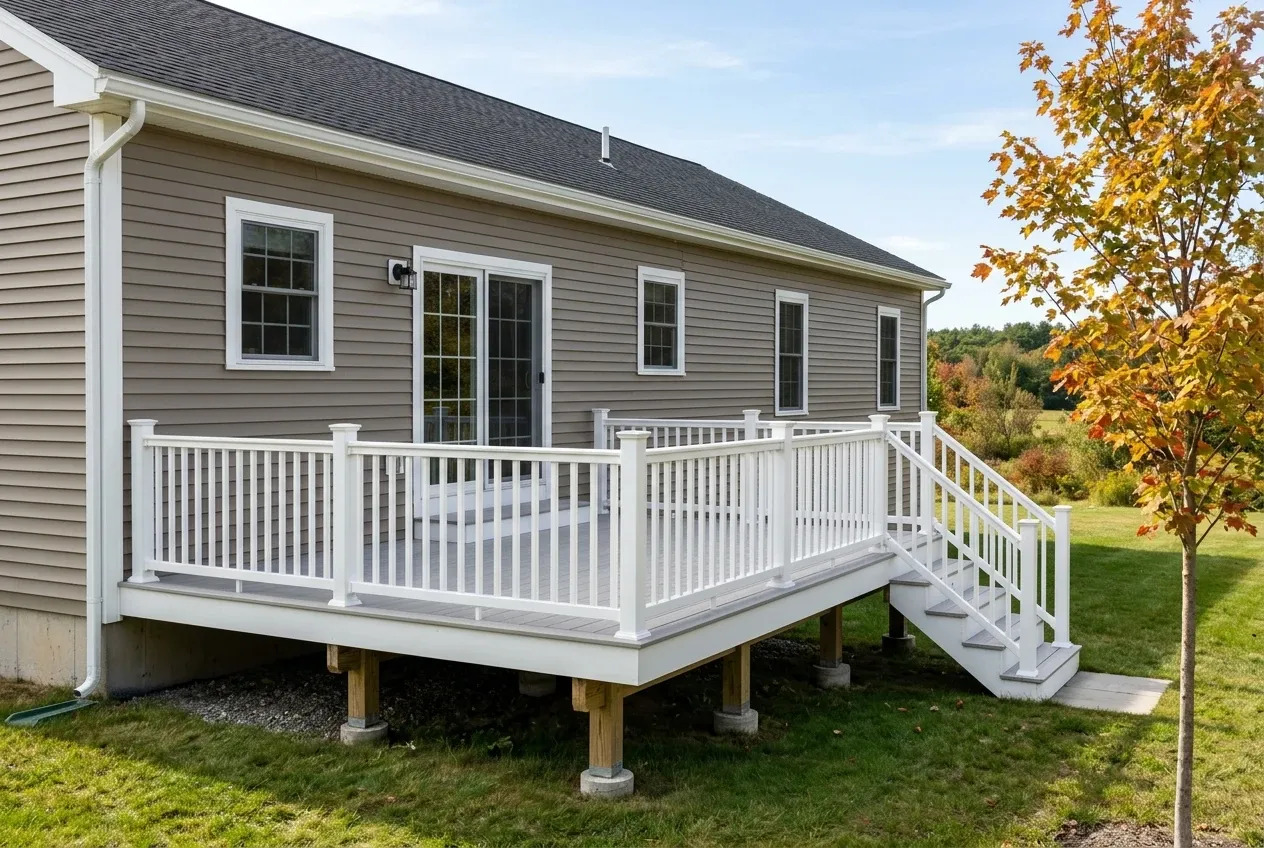
Who is better off replacing a deck than patching it?
The owner better off replacing a deck than patching it is one whose boards are being changed a few at a time as they fail. A patchwork deck is an old frame at the end of its life wearing newer boards.
Where does an old deck usually start to rot?
An old deck usually starts to rot where water sits: along the tops of the joists, at the band joist behind the ledger, and where posts meet the ground. The USDA's Wood Handbook explains why, noting that wood kept air dry will not decay.
When in the year should an old deck come down?
An old deck should come down between spring and fall, early enough for the new footings to go in before the ground locks up with frost. Where the town wants a permit, it is in hand before the tear-out starts.
How Much Should a Deck Replacement Cost?
A deck replacement should cost about what a new deck does, plus the tear-out. Across many quotes, a simple treated layout averages about $80 per square foot and a larger or more involved one $100 to $120 per square foot, and no new deck goes up for less than $10,000 when it is all treated wood, or $15,000 once composite or PVC boards and a composite rail go on.
| Deck | What it usually means | Average |
|---|---|---|
| Pressure-treated, simple layout | one level, a few steps, treated boards and rail, old deck removed | about $80 per square foot, nothing new under $10,000 |
| Bigger or more complex layout | levels, angles, wraparounds, tie-ins, more stairs | $100 to $120 per square foot |
| Composite or PVC | composite or PVC boards with composite rail on the new frame | from $15,000 |
Averages for a full replacement gathered from many quotes around Waterville, never a quote: new footings, frame, boards, rail and stairs, with the tear-out and haul-away on top. Height, the stairs and whatever the old deck has been hiding can shift the figure, and Trex and TimberTech are their makers' names, with no tie to us.
Why not put new boards on the old frame?
We do not put new boards on an old frame because that saves the cheapest part of the deck and keeps the part that fails, so every replacement we build gets a new frame. TimberTech's own advice for a new surface is to check an old frame for cracks, splits and spongy wood and to replace it when the damage is significant, which after two decades outdoors it usually is.
What moves a deck replacement price inside the range?
A deck replacement price moves in the same order as a new deck's: a ramp, the stairs and how many, any usable footings already in place, the layout's complexity and the height. The tear-out and haul-away sit on top of those, and staging for a deck standing over roughly 2 feet adds about a crew day.
Can the old posts or footings stay?
The old posts almost never stay, because they belong to the frame we are replacing, but footings that are sound and deep enough sometimes can. We decide that after we look at them, and the price follows what we find.
Is Your Old Deck Ready to Come Down?
Ask for a visit and we crawl under the old deck, say plainly whether it has to go, and price the tear-out and the new deck on separate lines. The estimate request is free, and nothing comes off your house until you have signed.